

-
1 диапазон номинальных частот
диапазон номинальных частот
Диапазон частот, установленный изготовителем для прибора, выраженный верхним и нижним пределами.
[ ГОСТ Р 52161. 1-2004 ( МЭК 60335-1: 2001)]EN
rated frequency range
frequency range assigned to the appliance by the manufacturer, expressed by its lower and upper limits
[IEC 60335-1, ed. 4.0 (2001-05)]FR
plage assignée de fréquences
plage des fréquences attribuée à l'appareil par le fabricant, exprimée par ses limites inférieure et supérieure
[IEC 60335-1, ed. 4.0 (2001-05)]Тематики
EN
FR
Русско-французский словарь нормативно-технической терминологии > диапазон номинальных частот
-
2 номинальная частота
номинальная частота
Частота, указанная изготовителем на приборе.
[ ГОСТ Р 52161. 1-2004 ( МЭК 60335-1: 2001)]EN
rated frequency
frequency assigned to the appliance by the manufacturer
[IEC 60335-1, ed. 4.0 (2001-05)]FR
fréquence assignée
fréquence attribuée à l'appareil par le fabricant
[IEC 60335-1, ed. 4.0 (2001-05)]Тематики
EN
FR
Русско-французский словарь нормативно-технической терминологии > номинальная частота
-
3 номинальная частота fном
номинальная частота fном
Значение частоты, на работу при которой рассчитан трансформатор
(МЭС 421-04-03).
[ ГОСТ 30830-2002]EN
rated frequency
the frequency at which the transformer or reactor is designed to operate
[IEV number 421-04-03]FR
fréquence assignée
fréquence à laquelle le transformateur ou la bobine d'inductance sont destinés à fonctionner
[IEV number 421-04-03]Тематики
Классификация
>>>EN
DE
FR
Русско-французский словарь нормативно-технической терминологии > номинальная частота fном
-
4 ток холостого хода
ток холостого хода
Ток, протекающий через линейный вывод обмотки, к которой приложено номинальное напряжение (или напряжение ответвления) номинальной частоты, при разомкнутых остальных обмотках.
Примечания
1 Для трехфазного трансформатора током холостого хода считают среднеарифметическое значение токов холостого хода трех фаз.
2 Ток холостого хода одной обмотки обычно выражают в процентах номинального тока этой обмотки. Для многообмоточных трансформаторов этот процент относят к обмотке с наибольшей номинальной мощностью
(МЭС 421-06-02)
[ ГОСТ 30830-2002]EN
no-load current
the current flowing through a line terminal of a winding when a given voltage is applied at rated frequency, the other winding(s) being open-circuited
NOTE 1 – Normally the applied voltage is the rated voltage and the energized winding, if fitted with tappings, is connected on its principal tapping.
NOTE 2 – The no-load current of a winding is often expressed as a percentage of the rated current of the same winding
[IEV number 421-06-02]FR
courant à vide
courant arrivant à une borne de ligne d'un enroulement quand une tension donnée à la fréquence assignée est appliquée à cet enroulement, l'autre (ou les autres) enroulement(s) étant à circuit ouvert
NOTE 1 – Normalement, la tension appliquée est la tension assignée et l'enroulement d'excitation, s'il est muni de prises, est connecté sur sa prise principale.
NOTE 2 – Le courant à vide d'un enroulement est souvent exprimé en pourcentage du courant assigné de cet enroulement.
[IEV number 421-06-02]Тематики
Классификация
>>>EN
DE
FR
Русско-французский словарь нормативно-технической терминологии > ток холостого хода
-
5 начальный пусковой ток
начальный пусковой ток
Наибольшее действующее значение тока, потребляемого заторможенным электродвигателем переменного тока с короткозамкнутым ротором или магнитом переменного тока, у которого якорь установлен так, что создается максимальный воздушный зазор при номинальных напряжении и частоте.
Обозначение
символ IA
Примечание
Переходные процессы не принимают во внимание.
[ ГОСТ Р МЭК 60050-426-2006]EN
initial starting current
Symbol IA
highest r.m.s. value of current absorbed by an a.c. motor when at rest or by an a.c. magnet with its armature clamped in the position of maximum air gap when supplied at rated voltage and rated frequency
NOTE – Transient phenomena are ignored.
[IEV number 426-08-04]FR
courant initial de démarrage
valeur efficace la plus élevée du courant absorbé par un moteur à courant alternatif au repos ou par un électro-aimant à courant alternatif dont l’armature est bloquée dans la position donnant l’entrefer maximal lorsqu’il est alimenté à sa tension et à sa fréquence assignées
NOTE – Les phénomènes transitoires ne sont pas pris en compte.
[IEV number 426-08-04]
Тематики
EN
DE
- Anzugstrom, m
FR
Русско-французский словарь нормативно-технической терминологии > начальный пусковой ток
-
6 потери холостого хода
потери холостого хода
Активная мощность, потребляемая трансформатором при номинальном напряжении (или напряжении ответвления) и номинальной частоте на выводах одной из обмоток при разомкнутых остальных обмотках
(МЭС 421-06-01).
Примечание — Значения этих параметров должны быть отнесены к основному ответвлению, если в НД не указано другое ответвление.
[ ГОСТ 30830-2002]
потери холостого хода
потери х. х.
Потери, возникающие в трансформаторе в режиме холостого хода при номинальном напряжении и номинальной частоте
[ ГОСТ 16110-82]EN
no-load loss
the active power absorbed when a given voltage at rated frequency is applied to the terminals of one of the windings, the other winding(s) being open-circuited
NOTE – Normally the applied voltage is the rated voltage and the energized winding, if fitted with tappings, is connected on its principal tapping
[IEV number 421-06-01]FR
pertes à vide
puissance active absorbée quand une tension donnée à la fréquence assignée est appliquée aux bornes de l'un des enroulements, l'autre (ou les autres) enroulement(s) étant à circuit ouvert
NOTE – Normalement, la tension appliquée est la tension assignée et l'enroulement d'excitation, s'il est muni de prises, est connecté sur sa prise principale.
[IEV number 421-06-01]Тематики
Классификация
>>>Синонимы
- потери х. х.
EN
DE
FR
Русско-французский словарь нормативно-технической терминологии > потери холостого хода
-
7 реактивное сопротивление нулевой последовательности
реактивное сопротивление нулевой последовательности
-EN
zero sequence reactance
the quotient of the reactive fundamental component of zero sequence armature voltage, due to the presence of fundamental zero sequence armature current at rated frequency, by the value of that component of current, the machine running at rated speed
[IEV ref 411-50-16]FR
réactance homopolaire
quotient du terme fondamental de la composante réactive de la tension d'induit homopolaire, due à la présence du terme fondamental du courant d'induit homopolaire à fréquence assignée, par cette composante du courant, la machine tournant à sa vitesse assignée
[IEV ref 411-50-16]Тематики
- электротехника, основные понятия
EN
DE
FR
Русско-французский словарь нормативно-технической терминологии > реактивное сопротивление нулевой последовательности
-
8 реактивное сопротивление обратной последовательности
реактивное сопротивление обратной последовательности
-EN
negative sequence reactance
the quotient of the reactive fundamental component of negative sequence armature voltage, due to the sinusoidal negative sequence armature current at rated frequency, by the value of that component of current, the machine running at rated speed
[IEV ref 411-50-15]FR
réactance inverse
quotient du terme fondamental de la composante réactive de la tension d'induit inverse, due à la composante inverse du courant d'induit sinusoïdal à fréquence assignée, par la valeur de ce courant, la machine tournant à sa vitesse assignée
[IEV ref 411-50-15]Тематики
- электротехника, основные понятия
EN
- negative phase-sequence reactance
- negative sequence reactance
- subtransient reactance of negative phase
DE
FR
Русско-французский словарь нормативно-технической терминологии > реактивное сопротивление обратной последовательности
-
9 реактивное сопротивление прямой последовательности
реактивное сопротивление прямой последовательности
-EN
positive sequence reactance
the quotient of the reactive fundamental component of the positive sequence armature voltage, due to the sinusoidal positive sequence armature current at rated frequency, by the value of that component of current, the machine running at rated speed
[IEV ref 411-50-14]FR
réactance directe
quotient du terme fondamental de la composante réactive de la tension d'induit directe, due à la composante directe du courant d'induit sinusoïdal à fréquence assignée, par la valeur de ce courant, la machine tournant à sa vitesse assignée
[IEV ref 411-50-14]
Тематики
- электротехника, основные понятия
EN
DE
FR
Русско-французский словарь нормативно-технической терминологии > реактивное сопротивление прямой последовательности
-
10 асинхронное реактивное сопротивление
асинхронное реактивное сопротивление
-EN
asynchronous reactance
the quotient of the reactive component of the average voltage at rated frequency, assumed to be sinusoidal and balanced, applied to the armature winding of a machine rotating out of synchronism, and the average current component at the same frequency
[IEV ref 411-50-05]FR
réactance asynchrone
quotient de la composante réactive de la tension moyenne à la fréquence assignée, supposée sinusoïdale et symétrique, appliquée à l'enroulement d'induit d'une machine tournant hors synchronisme, par la composante du courant moyen à la même fréquence
[IEV ref 411-50-05]Тематики
- электротехника, основные понятия
EN
DE
FR
Русско-французский словарь нормативно-технической терминологии > асинхронное реактивное сопротивление
-
11 полное сопротивление короткого замыкания пары обмоток
полное сопротивление короткого замыкания пары обмоток
Сопротивление, равное Z = R + jХ, Ом, определяемое при номинальной частоте и расчетной температуре между выводами одной из обмоток пары, при замкнутой накоротко другой обмотке этой пары и разомкнутых остальных обмотках при их наличии. Для трехфазного трансформатора полное сопротивление короткого замыкания пары обмоток является полным сопротивлением фазы (в эквивалентной схеме соединения «звезда»).
В трансформаторе, имеющем обмотку с ответвлениями, полное сопротивление короткого замыкания относят к конкретному ответвлению. Если в НД не оговорено иное, выбирают основное ответвление.
Примечание — Полное сопротивление короткого замыкания пары обмоток может быть выражено в относительных значениях z, например в процентах базисного полного сопротивления короткого замыкания Zбаз той же обмотки пары
Z=100Z/Zбаз
Где Zбаз=U2/Sном
(для трехфазных и однофазных трансформаторов), Ом (U — напряжение (номинальное или напряжение ответвления) обмотки, к которой относятся Z и Zбаз, В; Sном — номинальная мощность основного ответвления трансформатора, В•А).
Относительное значение полного сопротивления короткого замыкания может быть также определено как отношение напряжения, приложенного к данной обмотке в опыте короткого замыкания, вызывающего протекание через эту обмотку номинального тока (либо тока ответвления), к номинальному напряжению этой обмотки (либо напряжению ответвления). Это приложенное напряжение определяют как напряжение короткого замыкания (МЭС 421-07-01) данной пары обмоток и, как правило, выражают в процентах
(МЭС 421-07-02).
[ ГОСТ 30830-2002]EN
short-circuit impedance of a pair of windings
the equivalent star connection impedance related to one of the windings, for a given tapping and expressed in ohms per phase, at rated frequency, measured between the terminals of a winding when the other winding is short-circuited
NOTE – This value is normally related to the appropriate reference temperature
[IEV number 421-07-02]FR
impédance de court-circuit d'une paire d'enroulements
impédance équivalente en connexion étoile, rapportée à l'un des enroulements, pour une prise donnée et exprimée en ohms par phase, à la fréquence assignée, mesurée aux bornes d'un enroulement lorsque l'autre enroulement est en court-circuit
NOTE – Cette valeur est normalement rapportée à une température de référence appropriée.
[IEV number 421-07-02]Тематики
Классификация
>>>EN
DE
FR
Русско-французский словарь нормативно-технической терминологии > полное сопротивление короткого замыкания пары обмоток
-
12 полное сопротивление нулевой последовательности (трехфазной обмотки)
полное сопротивление нулевой последовательности (трехфазной обмотки)
Полное сопротивление обмотки фазы в омах при номинальной частоте между соединенными вместе линейными выводами трехфазной обмотки, соединенной по схеме «звезда» или «зигзаг», и выводом ее нейтрали
(МЭС 421-07-04).
Примечания
1 Полное сопротивление нулевой последовательности обмотки может иметь несколько значений, зависящих от способов соединения и нагрузки другой(их) обмотки(ок).
2 Полное сопротивление нулевой последовательности может зависеть от значений тока и температуры, особенно в трансформаторах, не имеющих обмоток, соединенных в «треугольник».
3 Полное сопротивление нулевой последовательности может быть выражено в относительных значениях, так же как и полное сопротивление короткого замыкания (прямой последовательности)
[ ГОСТ 30830-2002]EN
zero-sequence impedance (of a polyphase winding)
the impedance, expressed in ohms per phase at rated frequency, between the line terminals of a polyphase star or zigzag-connected winding connected together and its neutral terminal
[IEV number 421-07-04]FR
impédance homopolaire (d'un enroulement polyphasé)
impédance, exprimée en ohms par phase à la fréquence assignée, entre les bornes de ligne d'un enroulement polyphasé en étoile ou en zigzag reliées ensemble et sa borne de neutre
[IEV number 421-07-04]Тематики
Классификация
>>>EN
DE
FR
Русско-французский словарь нормативно-технической терминологии > полное сопротивление нулевой последовательности (трехфазной обмотки)
-
13 ток намагничивания трансформатора тока
ток намагничивания трансформатора тока
Действующее значение тока, потребляемого вторичной обмоткой трансформатора тока, когда ко вторичным зажимам подведено синусоидальное напряжение номинальной частоты, причем первичная обмотка и все остальные обмотки разомкнуты.
[ ГОСТ 18685-73]EN
exciting current
the r.m.s. value of the current taken by the secondary winding of a current transformer, when a sinusoidal voltage of rated frequency is applied to the secondary terminals, the primary and any other windings being open-circuited
[IEV number 321-02-32]FR
courant d'excitation
valeur efficace du courant qui traverse l'enroulement secondaire d'un transformateur de courant, lorsqu'on applique entre les bornes secondaires une tension sinusoïdale à la fréquence assignée, l'enroulement primaire et tous les autres enroulements étant à circuit ouvert
[IEV number 321-02-32]Недопустимые, нерекомендуемые
EN
DE
- Erregerstrom, sekundärer
- sekundärer Erregerstrom
FR
Русско-французский словарь нормативно-технической терминологии > ток намагничивания трансформатора тока
-
14 номинальное напряжение ОПН
номинальное напряжение
Uн
Действующее значение напряжения промышленной частоты, которое ограничитель может выдерживать в течение 10 с в процессе рабочих испытаний. Номинальное напряжение должно быть не менее 1,25 наибольшего длительно допустимого рабочего напряжения.
[ ГОСТ Р 52725-2007]EN
rated voltage of an arrester
Ur
maximum permissible r.m.s. value of power-frequency voltage between its terminals at which it is designed to operate correctly under temporary overvoltage conditions as established in the operating duty tests
NOTE 1 The rated voltage is used as a reference parameter for the specification of operating characteristics.
NOTE 2 The rated voltage as defined in this standard is the 10 s power-frequency voltage used in the operating duty test after high-current or long-duration impulses. Tests used to establish the voltage rating in IEC 60099-1, as well as some national standards, involve the application of repetitive impulses at nominal current with power-frequency voltage applied. Attention is drawn to the fact that these two methods used to established rating do not necessarily produce equivalent values (a resolution to this discrepancy is under consideration).
[IEC 60099-4, ed. 2.0 (2004-05)]FR
tension assignée d'un parafoudre
Ur
valeur maximale de la tension efficace à fréquence industrielle admissible entre ses bornes pour laquelle le parafoudre est prévu pour fonctionner correctement dans des conditions de surtension temporaires comme il est défini dans les essais de fonctionnement
NOTE 1 La tension assignée est utilisée comme paramètre de référence pour la spécification des caractéristiques de fonctionnement.
NOTE 2 La tension assignée comme définie dans la présente norme est la tension à fréquence industrielle de 10 s, utilisée pour vérifier la stabilité après application des chocs de courant de grande amplitude ou de longue durée lors de l'essai de fonctionnement. Les essais utilisés pour définir la tension assignée dans la CEI 60099-1, ainsi que dans certaines normes nationales, impliquent l'application de chocs répétés au courant nominal pendant que la tension à fréquence industrielle est appliquée. On attire l'attention sur le fait que ces deux méthodes utilisées pour définir les valeurs assignées ne produisent pas nécessairement des valeurs équivalentes (une résolution de cette différence est à l'étude).
[IEC 60099-4, ed. 2.0 (2004-05)]Тематики
- высоковольтный аппарат, оборудование...
EN
FR
Русско-французский словарь нормативно-технической терминологии > номинальное напряжение ОПН
-
15 номинальное напряжение
номинальное напряжение
Напряжение, установленное изготовителем для прибора
[ ГОСТ Р 52161. 1-2004 ( МЭК 60335-1: 2001)]
номинальное напряжение Uном, кВ
Номинальное междуфазное напряжение электрической сети, для работы в которой предназначены коммутационные аппараты.
[ ГОСТ Р 52726-2007]
номинальное напряжение
Un
Напряжение, применяемое для обозначения или идентификации системы электроснабжения.
[ ГОСТ Р 51317.4.30-2008 (МЭК 61000-4-30:2008)]EN
rated voltage
voltage assigned to the appliance by the manufacturer
[IEC 60335-1, ed. 4.0 (2001-05)]
rated voltage
quantity value assigned, generally by the manufacturer, for a specified operating condition of a machine
[IEC 60034-18-41, ed. 1.0 (2006-10)]
rated voltage
input or output supply voltage for which equipment is designed or specified
[IEC 88528-11, ed. 1.0 (2004-03)]
rated voltage
specified value of the voltage at the terminals of the machine when operating at a rating. If unidirectional, the voltage is the arithmetic mean of the recurring waveform and if alternating it is the root mean square value of the fundamental frequency component of the recurring waveform
NOTE - In the case of a machine with a protective resistor permanently in series, the resistor is considered as an integral part of the machine
[IEC 60349-1, ed. 1.0 (1999-11)]
rated voltage
the value of voltage assigned by the manufacturer to a component, device or equipment and to which operation and performance characteristics are referred
NOTE - Equipment may have more than one rated voltage value or may have a rated voltage range.
[IEC 62497-1, ed. 1.0 (2010-02)]
rated voltage
reference voltage for which the cable is designed, and which serves to define the electrical tests
NOTE 1 - The rated voltage is expressed by the combination of two values: Uo/U expressed in volts (V):
Uo being the r.m.s. value between any insulated conductor and "earth" (metal covering of the cable or the surrounding medium);
U being the r.m.s. value between any two phase conductors of a multicore cable or of a system of single-core cables.
In an alternating-current system, the rated voltage of a cable is at least equal to the nominal voltage of the system for which it is intended.
This condition applies both to the value Uo and to the value U.
In a direct current system, the nominal voltage of the system is not higher than 1,5 times the rated voltage of the cable.
NOTE 2 - The operating voltage of a system may permanently exceed the nominal voltage of such a system by 10 %. A cable can be used at a 10 % higher operating voltage than its rated voltage if the latter is at least equal to the nominal voltage of the system
[IEC 60245-1, ed. 4.0 (2003-12)]
rated voltage
highest allowable voltage between the conductors in a twin and multi conductor cable, or between one conductor and an electrical conductive screen, or between the two ends of a single core cable, or earth in unscreened cables
[IEC 60800, ed. 3.0 (2009-07)]
rated voltage
the r.m.s. line-to-line voltage under rated conditions
Primary side of input transformer: ULN
Converter input: UVN
Converter output: UaN
Motor voltage: UAN
[IEC 61800-4, ed. 1.0 (2002-09)]
rated voltage
input or output voltage (for three-phase supply, the phase-to-phase voltage) as declared by the manufacturer
[IEC 62040-1, ed. 1.0 (2008-06)]
nominal voltage, Un
voltage by which a system is designated or identified
[IEC 61000-4-30, ed. 2.0 (2008-10)]FR
tension assignée
tension attribuée à l'appareil par le fabricant
[IEC 60335-1, ed. 4.0 (2001-05)]
tension nominale
tension assignée, généraleme<>value of voltage assigned by the manufacturer, to a componentnt par le constructeur pour des conditions spécifiées de fonctionnement de la machine
[IEC 60034-18-41, ed. 1.0 (2006-10)]
tension assignée
tension spécifiée aux bornes de la machine quand celle-ci fonctionne au régime assigné. Dans le cas d'une tension redressée, sa valeur est égale à la valeur moyenne de l'onde périodique. Dans le cas d'une tension alternative, sa valeur est égale à la valeur efficace de la composante fondamentale de l'onde périodique
NOTE - Dans le cas d'une machine équipée d'une résistance de protection connectée en permanence en série, la résistance est considérée comme faisant partie intégrante de la machine
[IEC 60349-1, ed. 1.0 (1999-11)]
tension assignée
valeur de la tension, assignée par le constructeur à un composant, à un dispositif ou à un matériel, et à laquelle on se réfère pour le fonctionnement et pour les caractéristiques fonctionnelles
NOTE - Les matériels peuvent avoir plusieurs valeurs ou une plage de tensions assignées.
[IEC 62497-1, ed. 1.0 (2010-02)]
tension assignée
tension de référence pour laquelle le conducteur ou le câble est prévu et qui sert à définir les essais électriques
NOTE 1 - La tension assignée est exprimée par la combinaison de deux valeurs Uo /U, exprimées en volts (V):
Uo étant la valeur efficace entre l'âme d'un conducteur isolé quelconque et la «terre» (revêtement métallique du câble au milieu environnant);
U étant la valeur efficace entre les âmes conductrices de deux conducteurs de phase quelconques d'un câble multiconducteur ou d'un système de câbles monoconducteurs ou de conducteurs.
Dans un système à courant alternatif, la tension assignée d'un conducteur ou d’un câble est au moins égale à la tension nominale du système pour lequel il est prévu.
Cette condition s'applique à la fois à la valeur Uo et à la valeur U.
Dans un système à courant continu, la tension nominale admise du système n’est pas supérieure à 1,5 fois la tension assignée du conducteur ou du câble.
NOTE 2 - La tension de service d'un système peut en permanence dépasser la tension nominale dudit système de 10 %. Un conducteur ou un câble peut être utilisé à une tension de service supérieure de 10 % à sa tension assignée si cette dernière est au moins égale à la tension nominale du système
[IEC 60245-1, ed. 4.0 (2003-12)]
tension assignée
tension maximale admissible entre les âmes dans un câble ayant une paire ou multi conducteur ou entre une âme et un écran conducteur électrique ou avec la terre pour un câble non écranté ou encore entre les deux extrémités d’un câble à âme unique
[IEC 60800, ed. 3.0 (2009-07)]
tension assignée
valeur efficace de la tension de ligne (entre phases) dans les conditions assignées
Primaire du transformateur d’entrée: ULN
Entrée du convertisseur: UVN
Sortie du convertisseur: UaN
Moteur: UAN
[IEC 61800-4, ed. 1.0 (2002-09)]
tension assignée
tension d’alimentation d’entrée ou de sortie (dans le cas d’une alimentation triphasée, tension entre phases) déclarée par le constructeur
[IEC 62040-1, ed. 1.0 (2008-06)]
tension nominale, Un
tension par laquelle un réseau est désigné ou identifié
[IEC 61000-4-30, ed. 2.0 (2008-10)]Тематики
- аппарат, изделие, устройство...
- высоковольтный аппарат, оборудование...
- прибор электрический
- электроснабжение в целом
Синонимы
- Un
EN
FR
Русско-французский словарь нормативно-технической терминологии > номинальное напряжение
-
16 прямой пуск вращающегося электродвигателя
прямой пуск вращающегося электродвигателя
Пуск вращающегося электродвигателя путем непосредственного подключения его к питающей сети.
[ ГОСТ 27471-87]EN
direct-on-line starting
across-the-line starting (US)
the process of starting a motor by connecting it directly to the supply at rated voltage
[IEV number 411-52-15]FR
démarrage direct
mode de démarrage d'un moteur, consistant à lui appliquer directement sa pleine tension assignée
[IEV number 411-52-15]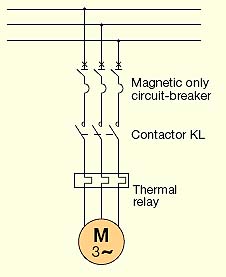
Рис. ABB
Схема прямого пуска электродвигателяMagnetic only circuit-breaker - Автоматический выключатель с электромагнитным расцепителем
Contactor KL - Контактор KL
Thermal relay - Тепловое реле
Параллельные тексты EN-RU
Direct-on-line starting
Direct-on-line starting, which is often abbreviated as DOL, is perhaps the most traditional system and consists in connecting the motor directly to the supply network, thus carrying out starting at full voltage.Direct-on-line starting represents the simplest and the most economical system to start a squirrel-cage asynchronous motor and it is the most used.
As represented in Figure 5, it provides the direct connection to the supply network and therefore starting is carried out at full voltage and with constant frequency, developing a high starting torque with very reduced acceleration times.
The typical applications are relevant to small power motors also with full load starting.
These advantages are linked to some problems such as, for example, the high inrush current, which - in the first instants - can reach values of about 10 to 12 times the rated current, then can decrease to about 6 to 8 times the rated current and can persist to reach the maximum torque speed.The effects of such currents can be identified with the high electro-dynamical stresses on the motor connection cables and could affect also the windings of the motor itself; besides, the high inrush torques can cause violent accelerations which stress the transmission components (belts and joints) generating distribution problems with a reduction in the mechanical life of these elements.
Finally, also the possible electrical problems due to voltage drops on the supply line of the motor or of the connected equipment must be taken into consideration.
[ABB]Прямой пуск
Прямой пуск, который по-английски часто сокращенно обозначают как DOL, является, пожалуй наиболее распространенным способом пуска. Он заключается в непосредственном (т. е. прямом) подключении двигателя к питающей сети. Это означает, что пуск двигателя осуществляется при полном напряжении.Схема прямого пуска является наиболее простым, экономичным и чаще всего применяемым решением для электродвигателей с короткозамкнутым ротором.
Схема прямого подключения к сети представлена на рисунке 5. Пуск осуществляется при полном напряжении и постоянной частоте сети. Электродвигатель развивает высокий пусковой момент при коротком времени разгона.
Типичные области применения – маломощные электродвигатели, в том числе с пуском при полной нагрузке.
Однако, наряду с преимуществами имеются и определенные недостатки, например, бросок пускового тока, достигающий в первоначальный момент 10…12-кратного значения от номинального тока электродвигателя. Затем ток двигателя уменьшается примерно до 6…8-кратного значения номинального тока и будет держаться на этом уровне до тех пор, пока скорость двигателя не достигнет максимального значения.
Такое изменение тока оказывает значительное электродинамическое воздействие на кабель, подключенный к двигателю. Кроме того пусковой ток воздействует на обмотки двигателя. Высокий начальный пусковой момент может привести к значительному ускорению и следовательно к значительной нагрузке элементов привода (ремней, крепления узлов), что вызывает сокращение их срока службы.
И, наконец, следует принять во внимание возможное возникновение проблем, связанных с падением напряжения в линии питания двигателя и подключенного к этой линии оборудования.
[Перевод Интент]
Тематики
Синонимы
EN
- across-the-line starting (US)
- direct line starting
- direct operation of a motor
- direct starting
- direct-on-line starting
- DOL
- full voltage starter application
DE
FR
Русско-французский словарь нормативно-технической терминологии > прямой пуск вращающегося электродвигателя
-
17 длительный допустимый ток
- courant permanent admissible, m
- courant admissible, m
(длительный) допустимый ток
Максимальное значение электрического тока, который может протекать длительно по проводнику, устройству или аппарату при определенных условиях без превышения определенного значения их температуры в установившемся режиме
[ ГОСТ Р МЭК 60050-826-2009]
Этот ток обозначают IZ
[ ГОСТ Р 50571. 1-2009 ( МЭК 60364-1: 2005)]EN
(continuous) current-carrying capacity
ampacity (US)
maximum value of electric current which can be carried continuously by a conductor, a device or an apparatus, under specified conditions without its steady-state temperature exceeding a specified value
[IEV number 826-11-13]
ampacity
The current in amperes that a conductor can carry continuously under the conditions of use without exceeding its temperature rating.
[National Electrical Cod]FR
courant (permanent) admissible, m
valeur maximale du courant électrique qui peut parcourir en permanence, un conducteur, un dispositif ou un appareil, sans que sa température de régime permanent, dans des conditions données, soit supérieure à la valeur spécifiée
[IEV number 826-11-13]Ampacity, the term is defined as the maximum amount of current a cable can carry before sustaining immediate or progressive deterioration. Also described as current rating or current-carrying capacity, is the RMS electric current which a device can continuously carry while remaining within its temperature rating. The ampacity of a cable depends on:
- its insulation temperature rating;
- conductor electrical properties for current;
- frequency, in the case of alternating currents;
- ability to dissipate heat, which depends on cable geometry and its surroundings;
- ambient temperature.
Electric wires have some resistance, and electric current flowing through them causes voltage drop and power dissipation, which heats the cable. Copper or aluminum can conduct a large amount of current before melting, but long before the conductors melt, their insulation would be damaged by the heat.
The ampacity for a power cable is thus based on physical and electrical properties of the material & construction of the conductor and of its insulation, ambient temperature, and environmental conditions adjacent to the cable. Having a large overall surface area may dissipate heat well if the environment can absorb the heat.
In a long run of cable, different conditions govern, and installation regulations normally specify that the most severe condition along the run governs the cable's rating. Cables run in wet or oily locations may carry a lower temperature rating than in a dry installation. Derating is necessary for multiple circuits in close proximity. When multiple cables are near, each contributes heat to the others and diminishes the amount of cooling air that can flow past the individual cables. The overall ampacity of the insulated conductors in a bundle of more than 3 must be derated, whether in a raceway or cable. Usually the de-rating factor is tabulated in a nation's wiring regulations.
Depending on the type of insulating material, common maximum allowable temperatures at the surface of the conductor are 60, 75 and 90 degrees Celsius, often with an ambient air temperature of 30°C. In the U.S., 105°C is allowed with ambient of 40°C, for larger power cables, especially those operating at more than 2 kV. Likewise, specific insulations are rated 150, 200 or 250°C.
The allowed current in cables generally needs to be decreased (derated) when the cable is covered with fireproofing material.
For example, the United States National Electric Code, Table 310-16, specifies that up to three 8 AWG copper wires having a common insulating material (THWN) in a raceway, cable, or direct burial has an ampacity of 50 A when the ambient air is 30°C, the conductor surface temperature allowed to be 75°C. A single insulated conductor in air has 70 A rating.
Ampacity rating is normally for continuous current, and short periods of overcurrent occur without harm in most cabling systems. The acceptable magnitude and duration of overcurrent is a more complex topic than ampacity.
When designing an electrical system, one will normally need to know the current rating for the following:- Wires
- Printed Circuit Board traces, where included
- Fuses
- Circuit breakers
- All or nearly all components used
Some devices are limited by power rating, and when this power rating occurs below their current limit, it is not necessary to know the current limit to design a system. A common example of this is lightbulb holders.
[http://en.wikipedia.org/wiki/Ampacity]
Тематики
- электротехника, основные понятия
Синонимы
EN
DE
- Dauerstrombelastbarkeit, f
- Strombelastbarkeit, f
FR
- courant admissible, m
- courant permanent admissible, m
Русско-французский словарь нормативно-технической терминологии > длительный допустимый ток
-
18 начальный пусковой момент асинхронного двигателя с короткозамкнутым ротором (синхронного двигателя, синхронного компенсатора)
начальный пусковой момент асинхронного двигателя с короткозамкнутым ротором (синхронного двигателя, синхронного компенсатора)
начальный пусковой момент
Минимальный измеренный момент, развиваемый асинхронным двигателем с короткозамкнутым ротором (синхронным двигателем, синхронным компенсатором) в заторможенном состоянии при номинальных значениях напряжения и частоты питающей сети.
[ ГОСТ 27471-87]EN
starting torque
the electromagnetic torque generated by the motor minus the ventilation and friction torques of the motor, over the starting period from zero speed to load speed at rated voltage and frequency
[IEV number 411-48-07]FR
couple de démarrage
couple électromagnétique développé par le moteur après déduction du couple de frottement et ventilation, pendant la période de démarrage de la vitesse nulle jusqu'à la vitesse de charge à tension et fréquence assignées
[IEV number 411-48-07]Тематики
Синонимы
EN
DE
FR
Русско-французский словарь нормативно-технической терминологии > начальный пусковой момент асинхронного двигателя с короткозамкнутым ротором (синхронного двигателя, синхронного компенсатора)
-
19 пусковой ток
пусковой ток
-EN
inrush current
transient current associated with energizing of transformers, cables, reactors, etc
[IEV number 448-11-30]
inrush current
Iin
current occurring during the transient period from the moment of switching to the steady-state condition
[IEC 60738-1, ed. 3.0 (2006-04)]
starting current
the steady-state r.m.s. current taken from the line over the starting period from zero speed to load speed with rated voltage and frequency applied
[IEV number 411-48-18]FR
courant d'appel
courant transitoire associé à la mise sous tension des transformateurs, câbles, bobines d'inductance, etc
[IEV number 448-11-30]
courant de démarrage
valeur efficace du courant en régime établi, absorbé par le moteur pendant la période de démarrage de la vitesse nulle jusqu'à la vitesse de charge minimale lorsqu'il est alimenté à la tension et à la fréquence assignées
[IEV number 411-48-18]Тематики
- машины электрические вращающиеся в целом
- электротехника, основные понятия
EN
DE
FR
Русско-французский словарь нормативно-технической терминологии > пусковой ток
См. также в других словарях:
rated frequency — vardinis dažnis statusas T sritis automatika atitikmenys: angl. nominal frequency; rated frequency vok. Nennfrequenz, f rus. номинальная частота, f pranc. fréquence nominale, f ryšiai: sinonimas – nominalusis dažnis … Automatikos terminų žodynas
nominal frequency — vardinis dažnis statusas T sritis automatika atitikmenys: angl. nominal frequency; rated frequency vok. Nennfrequenz, f rus. номинальная частота, f pranc. fréquence nominale, f ryšiai: sinonimas – nominalusis dažnis … Automatikos terminų žodynas
Variable-frequency drive — A variable frequency drive (VFD) is a system for controlling the rotational speed of an alternating current (AC) electric motor by controlling the frequency of the electrical power supplied to the motor.cite book | first=Sylvester J. |… … Wikipedia
Pulse Rated — Infobox Radio Station name = Pulse Rated airdate = frequency = [http://uk.pulserated.com/player.aspx?player=10 Listen Here] format = New, unsigned, and emerging music owner = Pulse Global website = [http://www.pulserated.com/ www.pulserated.com]… … Wikipedia
диапазон — 3.9 диапазон (range): Диапазон между пределами, выраженными заявленными значениями нижнего и верхнего пределов. Примечание Термин «диапазон», как правило, используют в различных модификациях. Он может представлять собой различные характеристики,… … Словарь-справочник терминов нормативно-технической документации
Номинальная частота — 2.2.6. Номинальная частота частота, указанная для машины изготовителем. Источник: ГОСТ 12.2.013.0 91: Система стандартов безопасности труда. Машины ру … Словарь-справочник терминов нормативно-технической документации
Transformer — This article is about the electrical device. For the toy line franchise, see Transformers. For other uses, see Transformer (disambiguation). Pole mounted distribution transformer with center tapped secondary winding. This type of transformer is… … Wikipedia
диапазон номинальной частоты — 3.2.8 диапазон номинальной частоты (rated frequency range): Диапазон частоты, указанный на машине изготовителем, заданный нижним и верхним пределами. Источник: ГОСТ Р МЭК 60745 1 2005: Машины ручные электрические. Безопасность и методы испытаний … Словарь-справочник терминов нормативно-технической документации
ГОСТ Р МЭК 60745-1-2005: Машины ручные электрические. Безопасность и методы испытаний. Часть 1. Общие требования — Терминология ГОСТ Р МЭК 60745 1 2005: Машины ручные электрические. Безопасность и методы испытаний. Часть 1. Общие требования оригинал документа: 3.5.2 безопасное сверхнизкое напряжение (safety extra low voltage): Напряжение, не превышающее 42 В… … Словарь-справочник терминов нормативно-технической документации
ГОСТ Р МЭК 60745-1-2009: Машины ручные электрические. Безопасность и методы испытаний. Часть 1. Общие требования — Терминология ГОСТ Р МЭК 60745 1 2009: Машины ручные электрические. Безопасность и методы испытаний. Часть 1. Общие требования оригинал документа: 3.45 безопасное сверхнизкое напряжение (safety extra low voltage): Номинальное напряжение, не… … Словарь-справочник терминов нормативно-технической документации
ГОСТ IEC 60745-1-2011: Машины ручные электрические. Безопасность и методы испытаний. Часть 1. Общие требования — Терминология ГОСТ IEC 60745 1 2011: Машины ручные электрические. Безопасность и методы испытаний. Часть 1. Общие требования: 3.5.2 безопасное сверхнизкое напряжение (safety extra low voltage): Напряжение, не превышающее 42 В между проводниками и… … Словарь-справочник терминов нормативно-технической документации
